
Electrical Power Guide for Factories in Taichung Industrial Park: Three-Phase Power and Contract Capacity
When leasing a factory in Taichung Industrial Park, confirming that three-phase power is available is only the first step. You also need to check the electrical panels, available amperage, contract capacity, and compatibility with equipment voltage requirements. This article covers key site inspection points, how to assess horsepower and power requirements, and the costs and responsibilities to clarify before adding equipment, helping businesses reduce the risk of downtime and additional electrical work after moving in.
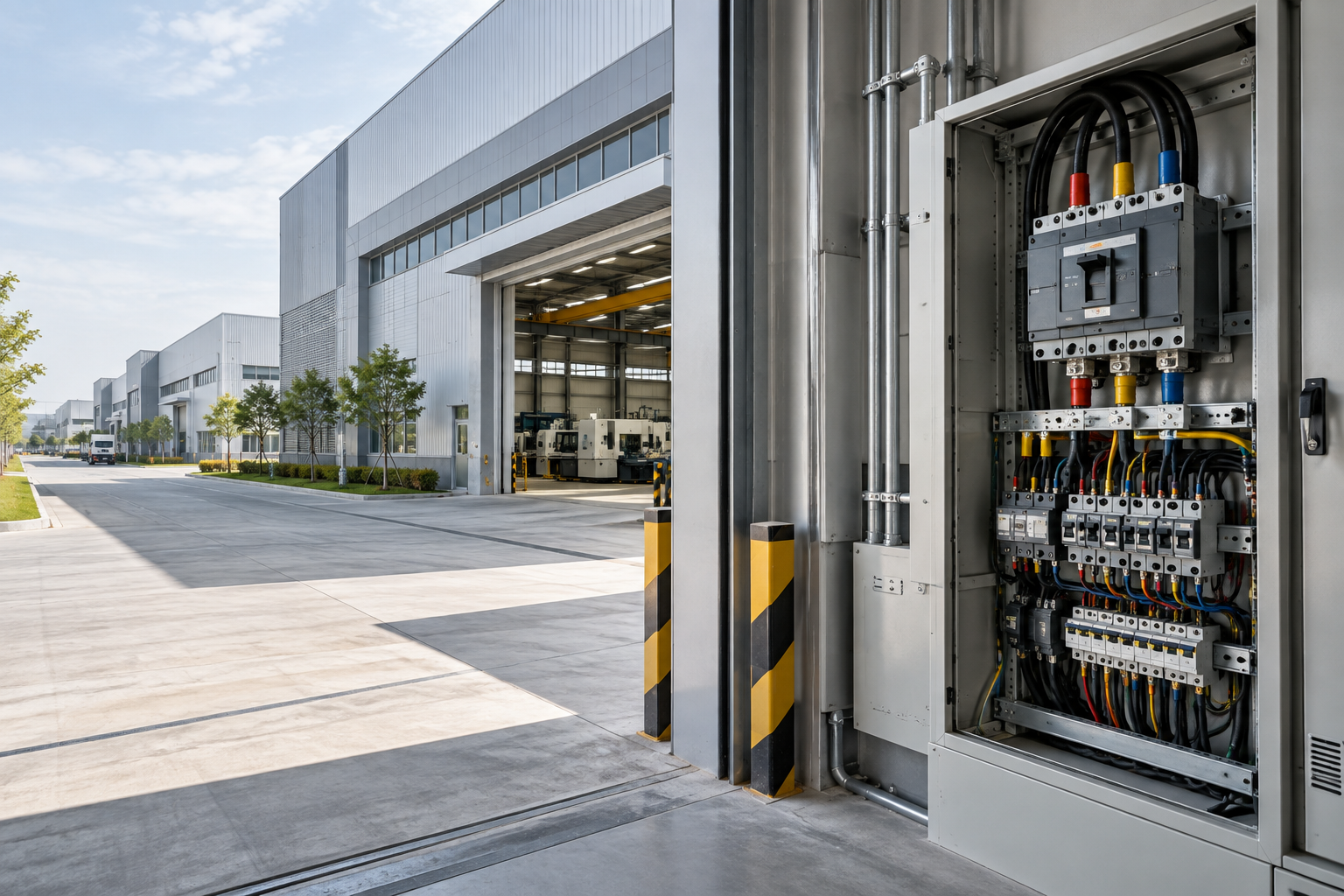
When searching for a factory in Taichung Industrial Park, electrical infrastructure is just as critical to a smooth production launch as floor area, ceiling height, and Floor Loading Capacity. Having electricity on-site does not mean it can power an entire production line. Likewise, a landlord's statement that three-phase power is available does not guarantee that the voltage, wiring, and supply capacity meet your equipment requirements. When evaluating leased premises in Taichung Industrial Park or developments such as the Alliance A-Park Green-Energy Smart Park, rely on supply data for the specific unit, on-site inspections, and professional calculations rather than assuming that park-wide electrical specifications apply to every unit.
1. Start with Equipment Requirements: Three-Phase Power May Not Be Enough
In industrial settings, power for motors and production equipment generally refers to a three-phase supply. However, suitability still depends on voltage, phase configuration, frequency, and distribution arrangements. Before a site inspection, businesses should prepare an equipment list covering at least:
- Each machine's rated voltage, phase configuration, frequency, and rated input current or power.
- Motor horsepower, starting method, and whether a variable-frequency drive is used.
- Equipment expected to operate simultaneously, operating hours, and shift schedules.
- Auxiliary loads such as air compressors, air conditioning, exhaust ventilation, lighting, and office areas.
- Power requirements for future production line expansion, additional shifts, and new equipment.
2. Inspect Electrical Panels: Trace the Supply from the Main Panel to the Leased Unit
During the site inspection, confirm exactly which electrical panel supplies the leased premises and how it connects to the site's main distribution panel and electricity meter. Do not assume the supply is adequate simply because you see wall outlets, switches, or a large electrical panel.
Begin by observing the condition, labels, and layout from a safe, accessible position. Ask the landlord to arrange any necessary internal inspections and measurements by qualified electrical professionals. Unqualified personnel should not open energized panels, touch terminals, or operate unidentified switches.
Recommended inspection items include:
- Equipment condition: Check panels for corrosion, water ingress, damage, unusual odors, or visible signs of overheating.
- Circuit labeling: Confirm that the main breaker, branch circuits, supply areas, and equipment names are clearly identified.
- Wiring and protection: Check that cable capacities, circuit breakers, and protective arrangements are properly matched.
- Grounding and maintenance: Verify that the grounding system is complete and that safe working clearance is maintained in front of panels.
- Expansion potential: Check for available circuits, panel space, and cable routes.
Spare space inside a panel does not mean there is spare capacity upstream. Nor does the amperage marked on a circuit breaker, by itself, prove that the entire system can sustain that current continuously. If the premises have been subdivided, modified, or expanded, it is especially important to compare distribution drawings with the actual installation.
3. Distinguish Available Amperage from Contract Capacity
Asking how many kilowatts or amperes the site can use is essential, but you also need to clarify what that figure represents: the main breaker's rating, the designed supply capacity, or the capacity actually available to the leased unit after accounting for other users. Amperage figures are only meaningfully comparable when considered alongside voltage, phase configuration, and the point of supply.
During the site inspection, confirm three distinct levels:
- Overall site capacity: How much load the upstream supply, transformers, main feeders, and main distribution panel can support.
- Allocation to the leased premises: How much current or power the unit is permitted to use, and whether the supply is shared with other tenants.
- Contract capacity: Whether the capacity agreed between the electricity account holder and the utility can support the projected demand.
Contract capacity relates to supply agreements and electricity billing. It is neither a circuit breaker specification nor the total electricity consumed over a month. Industrial contract capacity is commonly expressed in kilowatts, while equipment or transformer specifications may use kilovolt-amperes. These are not directly interchangeable; factors such as power factor must be considered.
4. Verify 220V and 380V Supplies to Prevent Incorrect Equipment Connections
When assessing 220V and 380V supplies, do not simply ask which voltage is available on-site. Confirm whether the supply is single-phase or three-phase, whether the stated voltage is line-to-line or line-to-neutral, and what wiring configuration the equipment requires. Identical voltage figures do not mean supplies are directly interchangeable.
For example, in a three-phase, four-wire 380/220V system, 380V generally refers to line-to-line voltage, while 220V refers to the voltage between a phase conductor and neutral. This does not mean that three-phase 220V power is available. The actual supply must be verified against the on-site system and professional measurements, not judged by the appearance of an outlet.
If equipment voltage requirements differ from the on-site supply, the equipment supplier and qualified electrical professionals should jointly confirm:
- Whether the equipment supports alternative voltages as manufactured, and whether its wiring can be adjusted in accordance with applicable specifications.
- Whether a transformer is required, along with its capacity, installation space, and heat dissipation requirements.
- Whether control power supplies, protective devices, and peripheral equipment also require modification.
- Whether imported equipment's frequency, phase sequence, and grounding requirements are compatible with on-site conditions.
Never connect 220V equipment to a 380V supply yourself, or assume that adding a transformer will resolve every issue. A transformer can change voltage, but it does not increase the existing upstream supply capacity. Transformer losses and the overall load must still be included in the assessment.
The following should be confirmed in writing:
- Supply voltage, phase configuration, point of supply, and available capacity at handover.
- Whether the electricity meter is dedicated to the unit; if a submeter is used, how readings are taken and charges calculated.
- How basic electricity charges, charges for exceeding contract capacity, and common-area electricity costs are allocated.
- Who pays for capacity upgrades, transformers, wiring, and application fees.
- Responsibilities for work approvals, planned outages, acceptance inspections, and reinstatement at the end of the lease.
Electrical work and related applications must comply with applicable electrical safety, building, and fire safety requirements. Consult qualified electrical professionals and the relevant authorities about the actual procedures. If the factory has solar photovoltaic, energy storage, or energy management equipment, separately verify how it supplies power and operates. Do not automatically treat it as capacity available to tenants or as backup power during an outage.
Conclusion
The core of an electrical assessment for a factory in Taichung Industrial Park is matching each equipment requirement to the actual supply conditions. Start by documenting equipment horsepower and electrical specifications, then inspect the panels, confirm the amperage available to both the site and the leased unit, and check contract capacity and voltage configurations. Recording the professional assessment findings, capacity upgrade conditions, and cost responsibilities in the lease documents helps reduce the risk of breaker trips, downtime, and additional electrical work after moving in.
This article provides general information only. Regulations, permits and lease terms should be confirmed case by case with qualified building, fire safety or legal professionals.
See the Park in Person
Book a Visit to Alliance A-Park Green Smart Park
Our team will guide your tour and help assess the right space for your operations.