
A Guide to Indoor Fire Extinguisher Placement and Service Life
Managing indoor fire extinguishers involves more than buying them and putting them in place. This article covers placement distances, quantity assessments, routine inspections, and service-life management for factories, warehouses, and offices. It also explains when extinguishers can be recharged, when they should be replaced, and the cost considerations for disposal and recycling, helping businesses balance fire safety with maintenance costs.
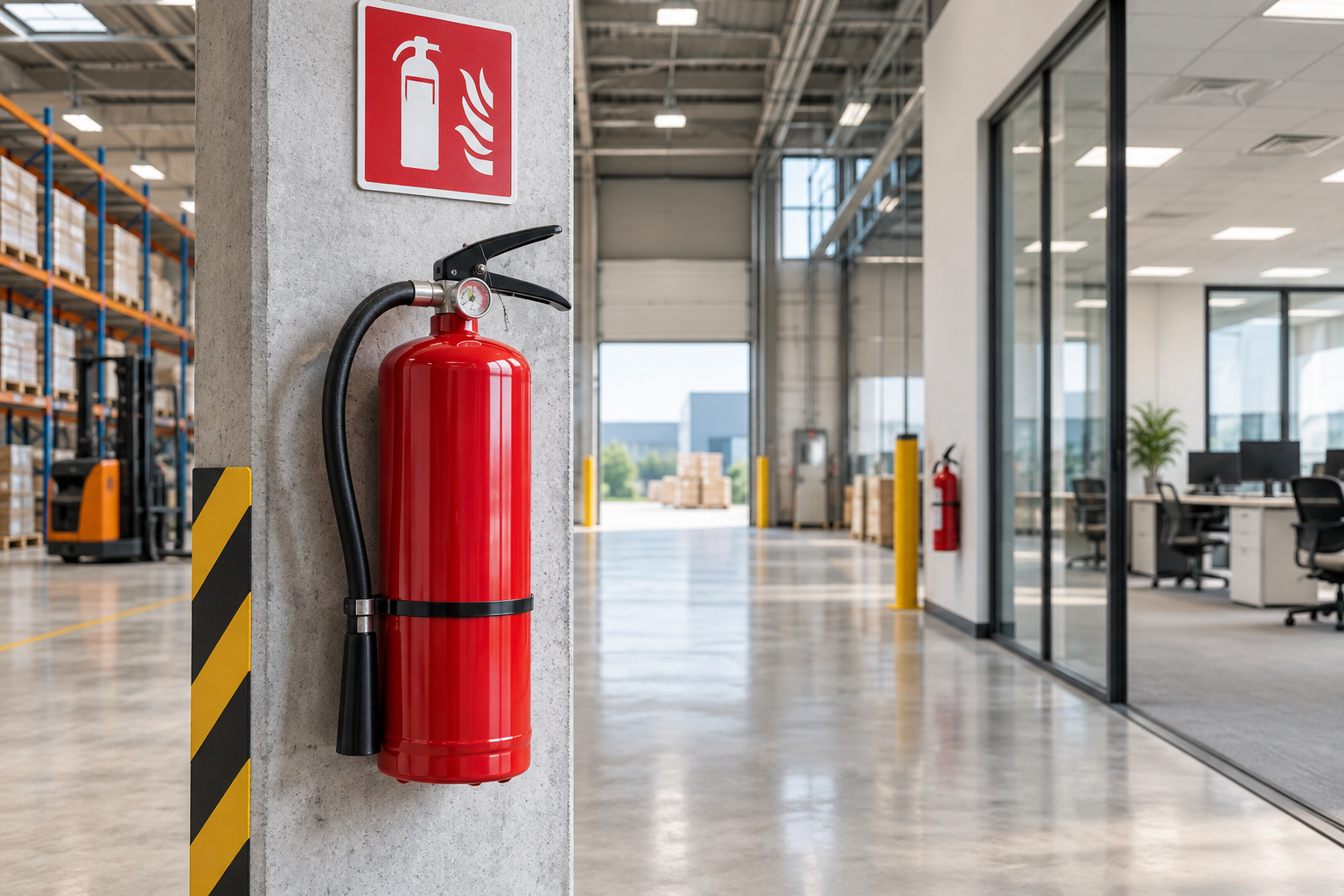
In industrial facilities such as Taichung Industrial Park and Alliance A-Park, fire extinguishers are essential equipment for responding to early-stage fires. However, having extinguishers on site does not mean they are properly positioned or ready for use. Businesses should manage their placement, fire ratings, service life, and maintenance records together. In particular, placement should be reassessed whenever partitions are added to a factory, warehouse shelving is rearranged, or a tenant changes production processes, rather than simply retaining the original locations.
1. Assess Site Risks Before Deciding on Types and Quantities
Indoor fire extinguisher provision in Taiwan should be determined under current regulations, including the Standards for Installation of Fire Safety Equipment Based on Use and Occupancy. Assessments must consider the premises' use, floor area, fire risks, and extinguisher fire ratings, rather than relying on rules of thumb such as “one per room” or “two per floor.”
The kilogram value marked on an extinguisher primarily indicates the amount of extinguishing agent, not the fire rating required by regulations. Even extinguishers with the same capacity should not be treated as interchangeable without verification. Before purchasing, review the following:
- General office and work areas: Identify risks from ordinary combustible materials such as paper, wood, and fabric, as well as electrical equipment.
- Areas containing oils, solvents, or specialized processes: Select suitable equipment based on material properties, storage arrangements, and operating conditions.
- Electrical distribution and precision equipment areas: Consider suitability for energized equipment, agent residue, potential equipment damage, and personnel safety.
- Areas with special hazards, such as metal powders: Do not assume that standard ABC dry chemical extinguishers are suitable; obtain a separate professional assessment.
Fire extinguishers cannot replace legally required indoor fire hydrants, automatic sprinklers, or other fire protection equipment. Before installation, have a qualified fire protection equipment engineer or technician verify the requirements against site conditions.
2. Measure Placement Distances Along Walking Routes, Not Simply by Area in ping
A key principle for general indoor placement is that the walking distance from any point on a floor to an extinguisher should not exceed 20 meters. The applicable requirements, quantities, and fire ratings must still be verified against the premises' classification and current regulations. Walking distance means the route people can actually use, not a straight-line radius on a floor plan.
For example, an extinguisher may be visible on the other side of a shelving unit, but reaching it may require walking around a long row of shelving. That detour must be included in the distance assessment. Even if the total quantity is sufficient based on floor area, additional extinguishers may be needed because of partitions, separate floors, or circulation routes.
Keep the following points in mind when positioning extinguishers:
- Place them in conspicuous, easily identifiable, and readily accessible locations, with signage installed as required.
- Do not allow pallets, cartons, machinery, or door panels to obstruct them. Avoid locking them in cabinets that require someone to find a key before opening.
- Secure them with suitable brackets or bases, comply with installation-height requirements, and avoid obstructing passage or evacuation routes.
- Avoid locations exposed to high temperatures, direct sunlight, moisture, corrosion, or potential forklift impacts.
- Do not group all extinguishers in one location. When positioning them near fire-risk areas, ensure they can still be approached safely if a fire starts.
Compliant provision is not just about the number of extinguishers. It also requires adequate fire ratings, practical access routes, unobstructed retrieval, and agents suitable for the fires that may occur.
Review the placement plan after renovations, mezzanine additions, changes of use, or shelving adjustments, and complete any relevant fire safety procedures where necessary.
3. Distinguish Between the Service Lives of Agents, Components, and Cylinders
An “expired extinguisher” may mean that maintenance is due, the agent needs attention, a component has failed, or the cylinder has reached the end of its service life. Each situation requires a different response.
Agent and maintenance intervals should be determined according to the extinguisher type, manufacturer labeling, and applicable inspection and maintenance requirements. Cylinder service life, by contrast, concerns pressure-vessel safety and cannot be extended by replacing the agent or applying a new maintenance label. Different types and designs should not be assigned a single service-life limit, nor should the latest recharge date be the only reference.
Businesses can establish an equipment register recording the following for each extinguisher:
- Location ID, type, specifications, and manufacturer.
- Manufacturing date, service-life limits shown on the product, and applicable maintenance requirements.
- Latest inspection, recharge, repair, and replacement records.
- Visible defects and the results of follow-up action.
If a cylinder shows corrosion, dents, leakage, fire damage, or illegible labeling, have it assessed by a professional even if it has not reached its service-life limit. Do not conceal defects with paint and continue using it.
4. Rechargeable Does Not Necessarily Mean Fit for Continued Use
Some extinguishers are designed to be rechargeable. Provided the cylinder remains fit for use, is within its service-life limit, and its valves and other components pass inspection, an appropriately qualified and equipped service provider may maintain and recharge it as a cost-control option.
However, “recharge it when it expires” is not a universal solution:
- Only the maintenance interval has elapsed: Inspect first, then determine whether agent replacement or recharging is needed under applicable regulations and product requirements.
- The extinguisher has been discharged: Even if only a small amount was used, remove it from normal standby service and send it for inspection and servicing.
- The product is non-rechargeable: Do not dismantle or modify it for recharging without authorization.
- The cylinder is beyond its service-life limit or fails safety requirements: Replace it; do not recharge it for continued use.
When requesting quotations, compare the total cost, including inspection, agent, components, transportation, and documentation, rather than just the recharge price. Arrange suitable replacement equipment while units are being serviced to avoid gaps in on-site fire protection.
5. Keep Records of Routine Inspections, Disposal, and Recycling
Businesses can include visual checks in their monthly internal inspections and increase the frequency according to risk. This is a management recommendation, not a substitute for legally required fire safety equipment inspections, maintenance, and reporting.
During checks, confirm that locations and signage are clear, access routes are unobstructed, safety pins and tamper seals are intact, nozzles and hoses are free of blockages or damage, and cylinders show no obvious corrosion or deformation. For models with pressure gauges, check that the needle is within the normal range. However, a normal reading does not guarantee that every function is working correctly. Some models have no pressure gauge and must be checked by weighing or other methods specified for the product. Do not briefly discharge an extinguisher yourself to test it.
When a cylinder exceeds its applicable service-life limit or is deemed unfit for further use, first provide replacement equipment. Then contact an appropriately qualified recycling or waste-treatment provider authorized to handle discarded extinguishers, or ask a fire equipment maintenance provider to arrange disposal. Confirm acceptance and the subsequent handling route in advance.
Whether disposal involves a fee or free recycling is available must be confirmed through a case-specific quotation. Costs may include residual agent handling, depressurization, sorting, transportation, and treatment. Do not assume that every recycling location accepts extinguishers free of charge. Never puncture or cut a cylinder yourself, or pour extinguishing agents into drainage systems. Retain records of equipment quantities and disposal documentation at handover, and update the equipment register.
Conclusion
Effective indoor fire extinguisher management depends on correct placement, readiness for use, and proper handling at the end of service life. When moving into Alliance A-Park or other industrial premises, businesses should clarify responsibility for common areas and leased spaces with property management, then have fire safety professionals verify on-site placement and maintenance needs. Rechargeable equipment should be serviced only when it meets the required conditions, while cylinders that exceed their service-life limits or fail safety requirements should be replaced. This approach helps maintain reliable early-stage fire protection at a reasonable cost.
This article provides general information only. Regulations, permits and lease terms should be confirmed case by case with qualified building, fire safety or legal professionals.
See the Park in Person
Book a Visit to Alliance A-Park Green Smart Park
Our team will guide your tour and help assess the right space for your operations.